
Introduction: Why self drilling screw is Critical in Light Steel Construction?
In Light Gauge Steel Framing (LGSF), self-drilling screws often act as the silent heroes—yet, conversely, they can just as easily become the hidden weak link. Although the steel frame forms the structural skeleton, it is actually the screws that bear the loads, resist dynamic forces, and ultimately safeguard the building’s overall integrity. Therefore, selecting the right fastener is not merely a technical detail; rather, it is a critical decision with far-reaching consequences. For instance, an incompatible screw can significantly reduce shear capacity, trigger premature pull-out under tensile stress, and, worse still, accelerate corrosion in Australia’s varied climate conditions. As a result, builders and engineers must prioritise screw performance from the very outset—not only to avoid costly failures but also to ensure long-term durability and compliance with local standards.
To meet the rigorous demands of modern prefabricated building fasteners, builders must first understand each screw’s specific role—from structural connections to sheathing attachment. Accordingly, this guide classifies screws by function, coating, and material, so that you can confidently select the right fastener for every Australian project.
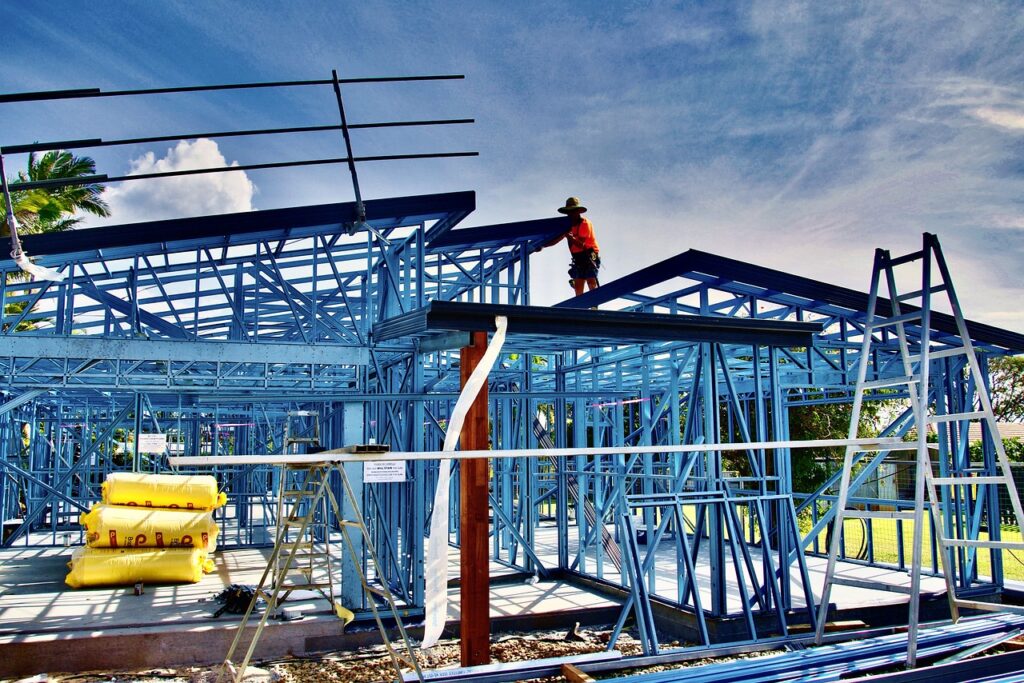
1. Detailed Classification by Function and Application
Not all screws perform the same, of course. In a typical LGSF project, you will therefore encounter several distinct types of light steel keel connectors, since each is specifically engineered for a particular task.
A. Structural Self-Drilling Screws (Tek Screws)
These are the workhorses of the frame. Unlike self-tapping screws (which require a pre-drilled pilot hole), self-drilling screws feature an integrated drill-bit tip (flute) that drills, taps, and fastens in one action.
- Tek 2 & Tek 3: Manufacturers typically design these screws for steel‑to‑steel connections where the total material thickness falls between 0.035″ and 0.050″, so these have become the standard choice for attaching studs to tracks.
- Tek 4 & Tek 5: Meanwhile, the other variant features a longer, heavier drill flute, and builders generally rely on these for heavy‑duty structural connections where steel thickness exceeds 1/8″—consequently, they are essential for connecting load‑bearing members that demand high shear strength.
B. Framing Screws (Pan Head / Wafer Head / Modified Truss Head)
Used primarily for connecting stud-to-track and track-to-structural supports.
- Pan Head & Wafer Head: These are typically #7 or #10 gauge screws with a low-profile head. The low profile allows for a flush surface, preventing interference when attaching interior finishes. They are crucial for providing pull-out resistance in the wall assembly.
- Modified Truss Head: The larger bearing surface of the modified truss head distributes the load more effectively, making it ideal for securing heavier gauge steel connections.
C. Sheathing / Drywall Screws
For attaching gypsum boards, plywood, or oriented strand board (OSB) to the metal framing.
- Bugle Head (#6 Gauge): The bugle head is designed to create its own countersink without tearing the paper surface of the drywall. The sharp point and specific thread count are optimised for quick penetration into steel studs without “strip-out.”
2. Technical Comparison: Coatings and Corrosion Resistance
In structural applications, a screw’s mechanical strength means nothing if it rusts away. For 耐腐蚀螺丝 轻钢房屋 (corrosion-resistant screws for light steel houses) , the coating is paramount.
| Coating Type | Corrosion Resistance | Typical Application |
|---|---|---|
| Electro-Galvanised (Zinc) | Basic (Interior, Dry) | Standard interior framing where moisture is not a concern. |
| Hot-Dip Galvanized | High (Exterior, Humid) | Exterior walls and roof connections requiring long-term weather exposure. |
| Ruspert / Delta-Mike | Very High (Industrial, Coastal) | High-end corrosion protection with excellent lubricity for installation; often specified in coastal areas. |
| Stainless Steel (SS304 / SS410) | Maximum (Marine, Chemical) | Required for treated lumber contact or in severe marine environments where even coated screws may fail. |
Note: Always check for compliance with ASTM fastener standards regarding coating thickness to ensure the stated corrosion resistance is reliable.
3. Commonly Applied Sizes in the Field
To give you a practical starting point, here are the most common sizes used in standard LGSF assemblies:
- For Structural Framing (Steel-to-Steel):
- #10 x 3/4″ Modified Truss Head Self-Drilling Screw
- #10 x 5/8″ Wafer Head Self-Drilling Screw
- *These sizes are typically classified as cold-formed thin-wall steel screws and must meet the mechanical properties of ASTM C954 for thicker steel.*
- For Sheathing Attachment:
- #6 x 1-1/4″ Bugle Head Screw (for single-layer drywall/plywood)
- #6 x 1-5/8″ Bugle Head Screw (for double-layer or thicker panels)
4. Purchasing Guide: Common Misconceptions to Avoid
Even experienced builders can fall into these traps. Here is how to navigate the self-drilling vs. self-tapping landscape safely:
- Misconception 1: “A screw is just a screw.”
- Reality: Using a standard self-tapping screw (which requires a pilot hole) in place of a self-drilling screw drastically slows down installation and risks damaging the steel framing.
- Misconception 2: “All zinc coatings are the same.”
- Reality: A cheap electro-galvanised screw will fail within months in an exterior application. Always specify the coating based on the environment. Look for reputable certifications that guarantee the screw meets specific salt spray test requirements.
- Misconception 3: “Harder steel is always better.”
- Reality: While case-hardened carbon steel is standard for structural screws, it must be ductile enough to handle shear forces without becoming brittle. Stainless steel (SS304) offers different mechanical properties and is chosen for corrosion, not necessarily for ultimate tensile strength over carbon steel.
By understanding the classification, application, and material science behind these critical fasteners, you ensure the longevity and safety of your light steel construction projects.