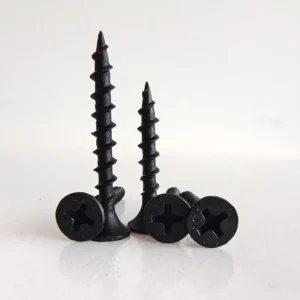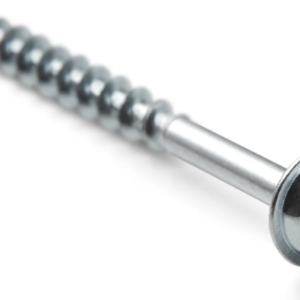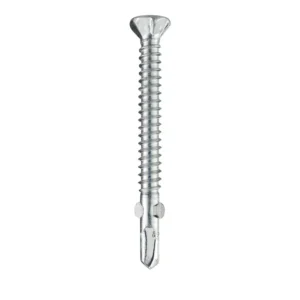
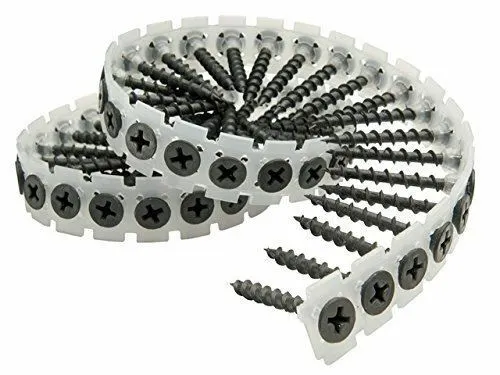
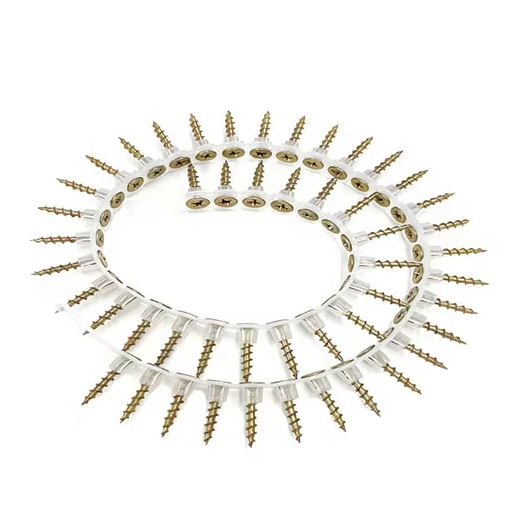
Collated Drywall Screws
Material: Stainless steel, Carbon steel, etc.
Head Style: Bugle Head
Driver types: Philips drive/Customised
Shank Size: #6, #8 /Customised
Thread types: Coarse (wood), Fine (metal)
Length: 1-1/4″, 1-5/8″, 2″/Customised
Coating: Plain, Grey/Black phosphate, Zinc-Plated, Dacromet, Ruspert, etc.
Strip counts: 20-25 screws per strip
Package: Carton box (1000pcs/ carton) – Pallet /Customized
Frequently Asked Questions About Collated Drywall Screws
Q1: What is the main advantage of collated drywall screws?
A: The primary benefit is speed and efficiency in professional drywall installation. Collated drywall screws feed automatically through an attachment, eliminating the need to place each screw manually. This significantly reduces installation time by up to 50-70% compared to loose screws while ensuring consistent depth and spacing throughout the project.
Q2: What screw gun do I need for collated drywall screws?
A: Collated drywall screws require an auto-feed screw gun system or a compatible collated attachment. Popular options include:
-
DeWalt collated attachments (compatible with most DeWalt screw guns)
-
Makita auto-feed systems
-
Senco collated screw guns
-
Universal collated attachments (check compatibility first)
Important: Standard drills or impact drivers are not compatible with collated screw strips.
Q3: What are the common thread types of collated drywall screws?
A: Thread types:
-
Coarse thread (Type S): For wood studs, OSB, and plywood
-
Fine thread (Type W): For metal studs (20-25 gauge)
Q4: Are collated drywall screws better than loose drywall screws?
A: It depends on your project scope:
For high-volume professional projects:
-
✅ Faster installation: Up to 3-5x faster than loose screws
-
✅ Consistent results: Automatic feeding ensures uniform depth
-
✅ Reduced fatigue: Less hand movement, more comfortable for long shifts
-
✅ Continuous work: No stopping to reload individual screws
For small DIY jobs:
-
Traditional loose drywall screws are more cost-effective
-
No need to invest in specialised auto-feed equipment
-
Suitable for occasional use and small repairs
Conclusion: For contractors and large-scale projects, collated drywall screws are superior. For homeowners doing occasional repairs, loose screws remain practical.
Q5: Do collated drywall screws work in corners and tight spaces?
A: Collated drywall screws can be more challenging in confined areas due to the size of the auto-feed mechanism. The screw gun with attachment requires more clearance than a standard drill. For:
-
Interior corners: Usually manageable with practice
-
Tight alcoves: May require switching to loose screws
-
Edge work: Typically fine with proper technique
Pro tip: Keep a few loose drywall screws handy for hard-to-reach spots where the collated attachment won’t fit.